Generative AI can make renders, but it can’t give you lighting plans (yet)

I’ve tried it, you’ve tried it, Generative AI’s first image is usually impressive.
Feed a prompt into ChatGPT Pro or Gemini Pro, describe a dining room, a material palette, and a mood, and you will get something that looks real. Quality renders. Plausible fixture choices. Light falling in intentional ways.
But it all falls apart when you try to change something.
Try to fix the pendant scale, and the wall finish shifts. Adjust the color temperature slightly and the whole image regenerates in a direction you didn't ask for. Ask it to place a table lamp, and it will put one somewhere that looks right in the frame but is wrong for the room. It all comes down to this: deciding where a lamp actually belongs requires weighing the sofa orientation, the ceiling height, the existing fixture layout, and what the lamp is supposed to do.
You can write all of that down as an instruction. The tool will follow the words. But it cannot make a judgment.
The most accurate parallel I have found for this phenomenon is this: there’s a difference between vibe coding and real programming.
That gap is not a prompting problem. It is a structural one.
What a buildable lighting proposal actually requires
A generated image and a lighting specification are not the same category of output. They look related, but they are solving different problems.
A lighting proposal is executable when it satisfies several constraints simultaneously and correctly. Not one at a time, not approximately, but together, in a real room, against real conditions.
Let’s start with placement.
Even given the exact right fixture, where it goes depends on the orientation and dimensions of the furniture below it. That information lives in the floor plan. If you upload a floor plan to a generative AI tool, it will either misread the geometry or spend enormous processing time trying to interpret it. The spatial relationship between a pendant and the sofa it is meant to light is not something these existing tools can reliably hold.
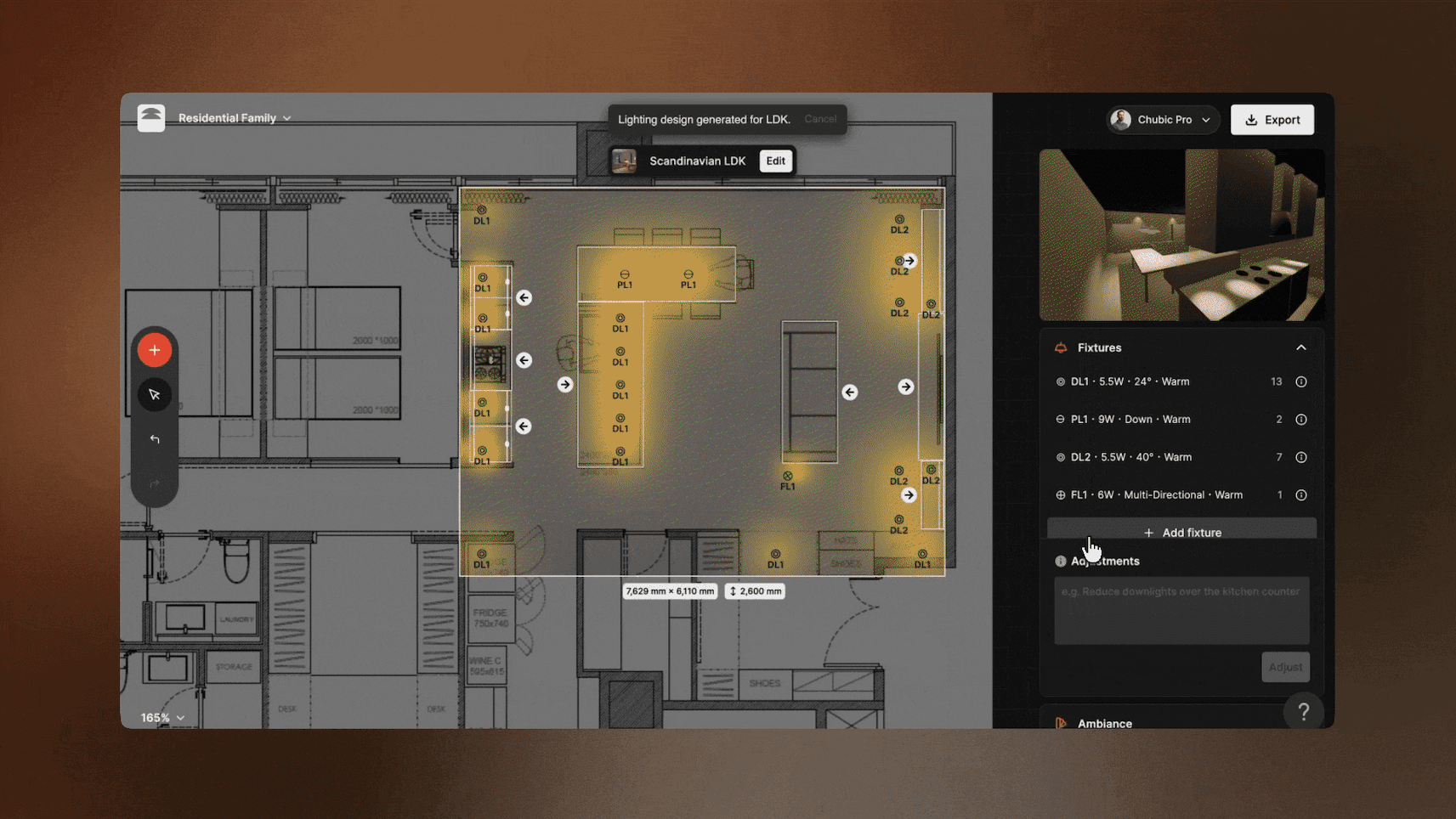
What a generic AI visual tool can't give you: fixtures placed, working together, on the real floor plan
Then there is interdependency.
On a recent project, the beam angle required from a trimless downlight (whether 18, 26, or 30 degrees) changed depending on which pendant was selected elsewhere in the room. One fixture choice physically altered what another fixture needed to do. A generated image has no mechanism for this. It shows you a result. It does not model the relationships around each fixture and how they interact with each other.
Furthermore, precision compounds the problem. Ask a generative tool to place downlights 30cm from a shelf, and it will approximate. That’s fine – it can follow a number written in a prompt. But it cannot reason about what that number means relative to the shelf height, the beam spread of the chosen fixture, and the surface the light is meant to hit. The instruction and the judgment are different things.
To top it all off, none of this touches budget or product availability: the practical ceiling every real project runs into, which a generated image has no awareness of at all.
My main argument is this: these tools were built to predict what a plausible image looks like. They were not built to hold physical constraint, dimension, structure, cost, fixture interdependency, or something real underneath the image. That is not a “gap” a better model fills.
But these tools aren’t useless; they are useful in certain scenarios.
What to trust these tools for, and what not to
I’m not arguing against using generative AI in a lighting workflow. My point is that it can be useful at the right stage.
These tools are genuinely useful for early ideation: no longer must you spend hours finding a decorative fixture that matches a rough description, generating a starting concept for a style direction like neo-Chinese or Japandi, or helping a client articulate what they want by reacting to images.
That is something you can delegate and where AI can assist. This is a real contribution to the front end of a project.
But what they cannot do is prioritize: Ask for lighting advice, and you will get a list of considerations with no governing principles, no way to know which constraint actually matters for this room, taking into account factors like ceiling height, furniture layout, or budget.
The output of mainstream generative AIs is unreliable when you get into the details of lighting.
But does that mean it’ll never get there?
No, not necessarily.
Closing this gap means building a tool around the constraints themselves, not around better-looking images. That is specifically the problem CHUBIC is working on: not generating more options, but modelling the spatial, physical, and product-level relationships that make a lighting decision real.
A hundred generated looks and one buildable lighting plan are not the same kind of output. The distance between them is the whole problem.
Jimmy Chu is a lighting designer with 15 years of experience leading AECOLIGHT. He is the founder of CHUBIC,a platform helping architects and interior designers make confident lighting decisions earlier in the design process.
